Blog
How to Get Good at LeetCode

https://www.youtube.com/watch?v=DprAKOl0R3E
LeetCode-style questions are still everywhere.
I recently polled 300+ engineers, and among those actively interviewing:
- 91% said they’re still getting LeetCode-style questions
- 62% said it’s basically everywhere

So people in my streams are always asking me if LeetCode is still important and the answer is YES!
So let’s talk about how to get good at it.
The Common (and Broken) Approach
Most people approach LeetCode the same way:
They open the site, pick a problem from a popular list — Blind 75, NeetCode 150, Peralta 75 — struggle for 45 minutes, maybe peek at the solution… and repeat.
That’s like opening a calculus textbook for the first time and jumping straight into problem sets without knowing derivatives or integrals.
You’re being asked to solve problems before you’ve learned the tools — so every question feels completely different, confusing, and random.
But once you actually learn the core patterns and techniques, solving problems stops being about “figuring it out from nothing.”
It becomes a much simpler task:
Look at the problem, recognize the shape, and pull the right tool from your toolbox.
From an Interviewers Perspective
Companies aren’t testing you to see if your a genius that can come up with a novel solution to a complex problem on the spot. The interviewer already knows the optimal solution and is expecting you to get there.
They’re testing whether you studied your fundamentals and can apply them to a problem you never seen before in a systematic way.
The process in most interviews is usually:
- recognize the underlying data structure
- identify the core pattern
- and combine them correctly to solve the problem
Introducing the LeetCode Pyramid
Instead of grinding randomly, you should think about LeetCode as a pyramid, where each layer builds on the one below it.
When you start at the bottom and work your way up — learning by doing at each layer — LeetCode starts to click.
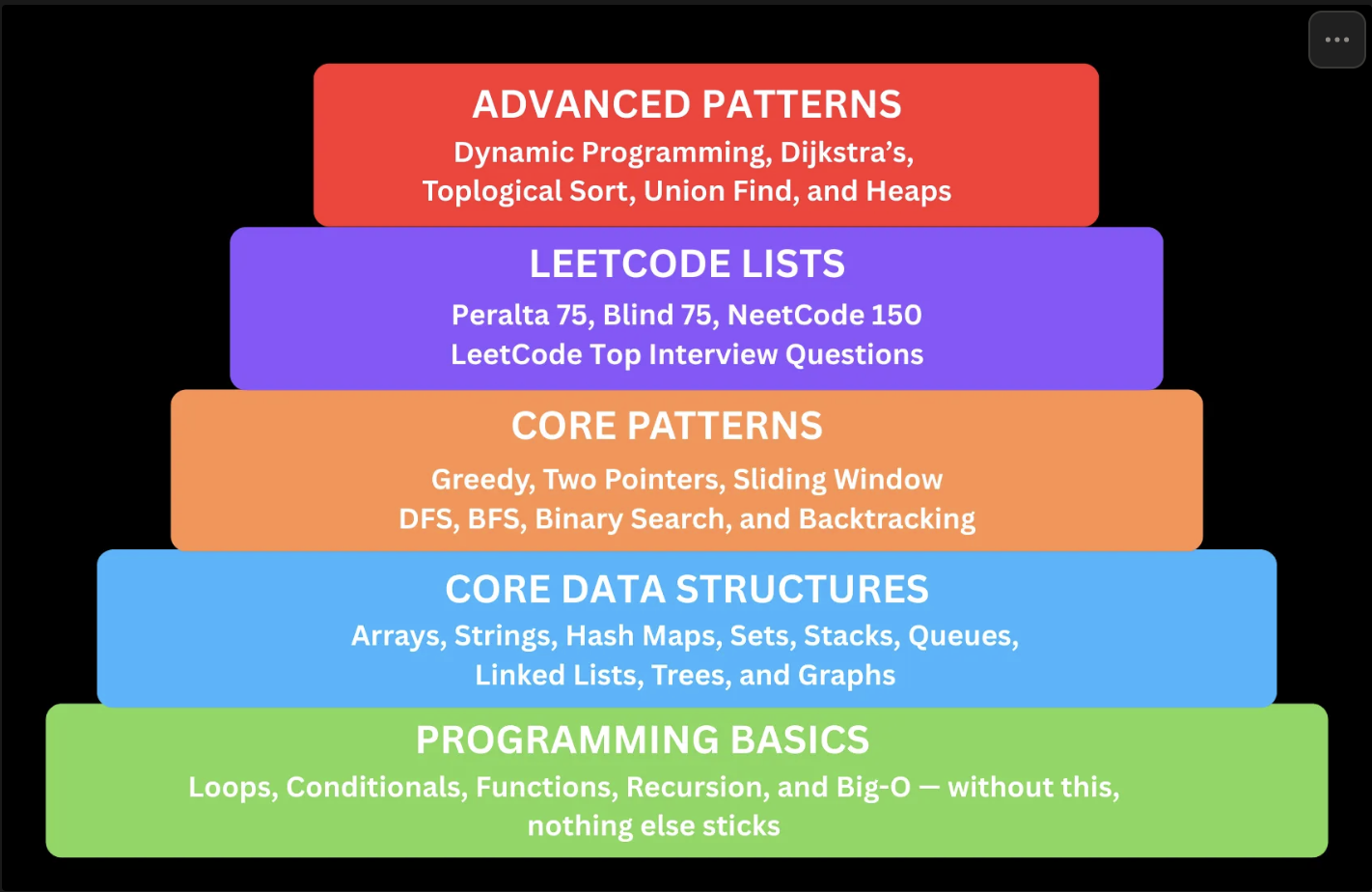
Layer 0: Programming Fundamentals
This is the foundation everything else sits on.
- Loops
- Conditionals
- Functions
- Recursion
- Big-O intuition
Theory
- Any Intro to Programming Course in your University
- CS50 (Harvard)
- Search topics like:
- “Loops in Python”
- “Conditionals in Python”
- “What is the call stack?”
Practice
- Ask ChatGPT to generate small exercises
- Have it grade your solutions
- Gradually increase difficulty
Layer 1: Core Data Structures
Data structures are how data is stored — and every coding pattern operates on one or more of them.
- Arrays & strings
- Hash maps / sets
- Stacks & queues
- Linked lists
- Trees
- Graphs
Theory
- Cracking the Coding Interview
- Elements of Programming Interviews
- Search topics like “Hash maps in Python”, “Trees explained”, etc.
Practice
- Implement each data structure from scratch
- Solve problems that explicitly use them
Layer 2: Core Patterns (This Covers ~80%)
Once data structures feel natural, you move on to coding patterns — the real heart of LeetCode.
- Two pointers
- Sliding window
- Binary search
- DFS / BFS
- Backtracking
- Greedy
Mastering these patterns alone will get you through most coding interviews.
Theory
- Grokking the Coding Interview
- Learn one pattern at a time
- Watch explanations that show multiple variations (I have a full coding patterns playlist that does exactly this)
Practice
- Solve problems only using that pattern
- Filter LeetCode problems by tag
- Don’t move on until the pattern feels obvious and you can implement it in 5-10 minutes,
Layer 3: LeetCode Lists
Only after mastering the earlier layers should you touch popular lists:
- Peralta 75
- Blind 75
- NeetCode 150
- Company-specific question sets
At this point, these lists become practice, not learning.
You already have the tools now you’re learning how to identify and apply them under pressure. Time yourself here - 30 minutes per interview is what you’ll usually get.
Layer 4: Advanced Techniques (~20%)
These topics show up less frequently, but still matter at top-tier companies.
Only learn these after the first three layers are solid.
- Dynamic Programming
- Heaps / priority queues
- Dijkstra’s algorithm
- Union Find
- Topological sort
How to practice:
- LeetCode Weekly Contests
- Advanced problem sets
- Zerotrac
Do Mock Interviews
Don’t skip this.
Mock interviews accelerate improvement more than almost anything else.
My friends and I did tons of these early on, and it made a massive difference.
Start with easier questions — but start early.
Try to do once per week at a minimum.
- Resources: Pramp, InterviewingIO, LeetCode Mock Assessments
Final Thoughts
LeetCode isn’t about grinding harder.
It’s about learning in the right order.
When you approach it systematically — layer by layer — problems stop feeling random, confidence goes up, and interviews become predictable.
Let me know what you think — and where you’re currently stuck in the pyramid.
If you like articles like this, I teach the same structured approach in much more depth on my YouTube channel, where I walk through coding patterns, LeetCode problems, and interview prep end-to-end. 👉 www.youtube.com/@jamesperaltaSWE
Was this page helpful?